AI Automation vs Traditional Automation: What’s the Difference?
Automation isn’t new. But the way businesses automate work is changing.
Traditional automation is excellent when a process follows predictable rules.
For example:
When a customer submits a form → add the customer to the CRM → send an email.
Simple. Predictable. Reliable.
But what happens when the customer writes:
“Hi, I need to book something next week, but I’m not sure which service I need. Can someone help?”
Now the workflow needs to understand language, context, and intent.
That’s where AI can become useful.
What is traditional automation?
Traditional automation follows predefined instructions.
Think:
IF this happens → THEN do that.
Examples include:
- Sending confirmation emails
- Moving data between applications
- Updating CRM records
- Creating tasks
- Sending notifications
- Scheduling recurring reports
Traditional automation is highly useful for predictable processes.
What is AI automation?
AI automation adds AI capabilities to the workflow.
Instead of only following fixed rules, an AI component can interpret information and make decisions within defined boundaries.
For example:
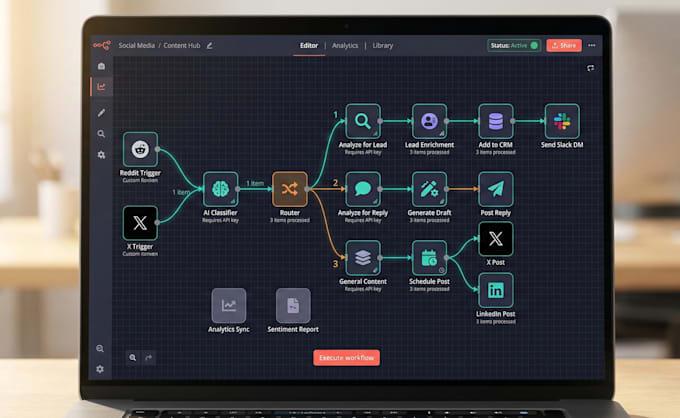
Customer message → AI understands intent → checks rules/data → chooses workflow → updates CRM → responds
This can be useful for:
- Customer conversations
- Lead qualification
- Document understanding
- Email classification
- Content processing
- AI assistants
- Research workflows
n8n describes this approach as combining AI with explicit workflow logic, integrations, human approvals, and guardrails.
The best systems often combine both
It’s not necessarily:
AI OR automation
It can be:
AI + automation
Imagine a customer support system.
AI handles:
“Understanding what the customer wants.”
Automation handles:
“Executing the correct process.”
For example:
Customer message
↓
AI identifies booking request
↓
Check availability
↓
Create appointment
↓
Update CRM
↓
Send confirmation
This is more powerful than using an AI chatbot alone.
When should you use traditional automation?
Use traditional automation when:
- Rules are clear
- Inputs are structured
- The process is predictable
- You need deterministic actions
When should you use AI automation?
AI can be useful when:
- Information is unstructured
- People communicate differently
- Text needs interpretation
- The workflow requires classification
- Customers need conversational interaction
- Documents need to be understood
A practical example
Suppose a company receives 100 inquiries every week.
A traditional workflow could:
Capture → Store → Notify
An AI-powered workflow could:
Capture → Understand → Qualify → Categorize → Update CRM → Respond → Book → Notify
The important part isn’t simply adding AI.
The important part is designing the entire process correctly.
Automation should solve a business problem
Don’t start with:
“Where can we put AI?”
Start with:
“Where is our business losing time?”
Then determine whether traditional automation, AI, or a combination of both is appropriate.
That’s how automation becomes a business tool rather than just another technology experiment.
CTA:
Not sure what to automate? Automytec can help identify repetitive processes and design a workflow around your business.